

HDPE Pipe Procurement Guidance for Global Water Infrastructure Projects
ANZHENG focuses on the research and production of high-standard water transportation piping, delivering reliable piping solutions for global municipal and agricultural water construction. Reasonable material selection determines the long-term operating effect of water infrastructure. Growing global investment in municipal water renovation and modern agricultural irrigation drives continuous upgrades for water delivery infrastructure. Construction contractors and field operators often encounter uncertainties during pipeline selection. Improper selection of substandard pipeline materials contributes to hidden water seepage, gradual material deterioration and potential water source contamination. These undesirable conditions bring persistent maintenance burdens and weaken the operational stability of water delivery networks. This article concludes practical selection guidelines for international engineering purchasers to avoid common errors during HDPE water delivery pipes configuration for water infrastructure construction.
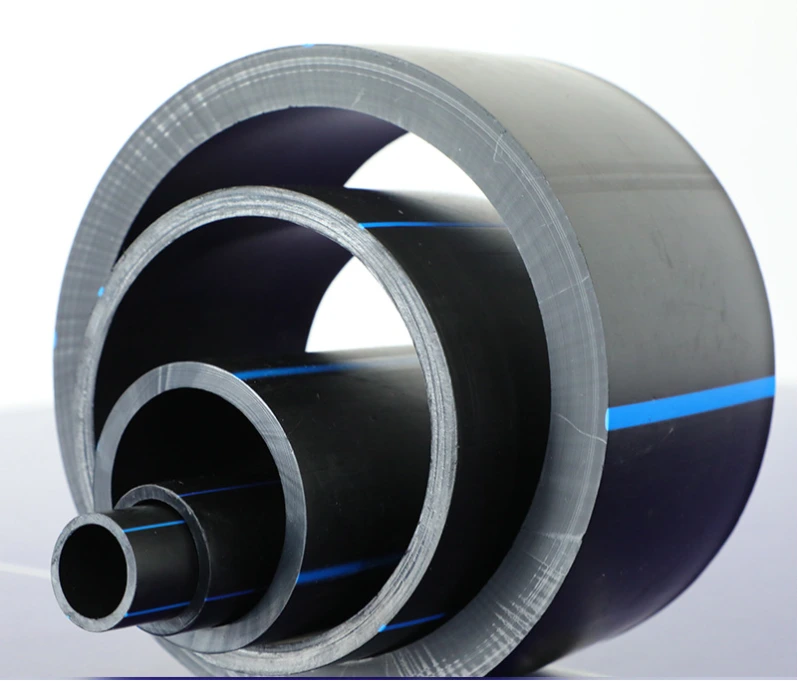
Distinctions Between Standard HDPE Water Delivery Pipes and Substandard Pipeline Materials
Most purchasing teams prioritize unit pricing while ignoring fundamental material attributes that determine long-term operational stability. Qualified HDPE water delivery pipes adopt food-safe non-toxic virgin resin and accurate extrusion techniques to form reliable structural conditions for potable water transportation.
Hydraulic performance serves as a vital evaluation indicator for water infrastructure construction. Eligible HDPE water delivery pipes feature uniformly smooth inner bore surfaces. Optimized inner structures reduce flow resistance and lower pressure loss throughout water transmission processes, cutting energy consumption for water pumping equipment. Such functional advantages deliver prominent benefits for large-area farm irrigation and urban water distribution networks. Substandard pipeline alternatives usually have rough inner wall textures. Long-term water flow operation causes internal sediment accumulation, impedes water circulation and reduces overall transmission efficiency.
Corrosion resistance and climate adaptation capacity act as indispensable checking dimensions. Buried water pipelines continuously contact soil chemical substances, humid ground layers and changing outdoor climate environments. Qualified HDPE water delivery pipes maintain stable structural integrity under chemical erosion and temperature fluctuation, extending usable cycles within standard working pressure ranges. Lightweight physical features simplify field transportation and on-site assembly, eliminating dependence on heavy mechanical equipment and shortening overall construction periods.
Practical Usage Limitations for HDPE Water Delivery Pipes
High-performance pressure pipelines carry definite application boundaries that require sufficient attention from purchasing and construction teams. Clear understanding of structural characteristics and application limits helps maximize the utilization value of HDPE water delivery pipes in various water engineering scenarios.
Temperature adaptability requires strict control throughout application processes. HDPE pipe structures suit cold and lukewarm water transportation, with sustainable working temperatures not exceeding 45°C. Sustained high-temperature water flow triggers material softening and structural deformation, generating joint gaps and latent leakage risks.
Overall operational stability depends on standardized field installation instead of inherent material quality alone. HDPE pipe connection relies on thermal fusion and electric fusion techniques. Most post-installation leakage problems derive from irregular construction behaviors, including unclean cutting sections, uneven fusion contact surfaces and inadequate standing time for solidification before pressure testing. Strict implementation of unified installation specifications effectively reduces subsequent operational hazards.
Typical Application Scenarios for HDPE Water Delivery Pipes
Stable pressure piping adapts to multiple water infrastructure construction scenarios. Municipal water systems apply such pipe structures for urban clean water transmission and pipe network renovation. Agricultural construction covers field irrigation, garden sprinkler arrangement and regional water distribution layout. Reliable structural conditions also fit residential water piping layout and non-corrosive liquid transmission in small-scale industrial environments.
Common specifications including 20 mm, 25 mm and 32 mm remain available for conventional construction. Dimensional adjustment supports large-scale engineering layout. Physical quality inspection through sample delivery is accessible for purchasers needing practical verification before large-scale arrangement. Professional teams provide timely inventory confirmation and sample arrangement services.
Effective Ways to Avoid Improper Low-Cost Pipeline Selection
Reasonable cost control matters in infrastructure arrangement, but excessive pursuit of extremely low unit pricing causes unsatisfactory operational results. Some manufacturing teams reduce production costs by incorporating recycled materials and simplifying production procedures. Pipes produced with reclaimed materials present insufficient hygienic conditions, weakened climate adaptation capacity and shortened service spans.
Comprehensive supplier evaluation needs to cover raw material grading, third-party detection credentials and standardized manufacturing proficiency, instead of merely referring to pricing data. Qualified water delivery pipe structures adopt pure virgin raw materials complying with international drinking water safety standards. Every production batch completes full procedural inspection before outgoing delivery. Professional teams maintain round-the-clock response mechanisms, covering installation guidance, structural matching consultation and targeted solutions for transit damage handling.
Rational Selection Suggestions for Water Infrastructure Decision Makers
HDPE pressure piping delivers high cost-efficiency for modern water infrastructure construction. Purchasing decisions need to prioritize raw material safety, temperature adaptation ranges, corrosion resistance and standardized installation specifications, rather than focusing solely on low unit pricing. Scientific material selection stabilizes long-term pipeline operation and reduces repetitive maintenance work for municipal and agricultural water projects.
For ongoing municipal water network upgrading, agricultural irrigation expansion and residential water piping arrangement, suitable pipe configurations deliver stable and durable support for various water transmission projects. Related technical documents and layout guidance are available for further reference.